The authors
Frédéric BARON
Inventor of the wall and collector of "I love you". Since 1992 Frederic Baron has collected more than 1,000 I love yous written in more than 300 languages and different dialects. It is in the streets of Paris that he made his tour of the world. In 1998 he wrote "The Book of I Love Yous" and distributed 50,000 free copies in France. A musician, he also recorded the magic phrase as spoken by most of the men, women and children he met. Author and composer, Frédéric Baron made his first record when he was 17 years of age, "The Key of the Sun". Since then he has written 40 love songs. In Montmartre he made his first appearances as a pianist at "Chez Ginette", "Au Tir Bouchon", and "Au Piano Bar", and it was there as well that he presented a song tour. Therefore, it is in Montmartre where he chose to create the wall.
An "I Love You" which says everything.
I took a long time to say Je t'aime. It was easier to say "ti amo" " te quiero". "je t'aime", but no, I was blocked. Today, I still need the intermediary of writing or music, which is why I compose love songs: "Je t'aime to destruction", "Dare to say je t'aime", "Never two without you". I dream of a real "I love you" which says all, which transgresses the wall of misunderstandings, which abolishes the border of differences.
It is in this vein that I began to collect I Love Yous in the original version. It was not just a collector's hobby. It was rather a way to go around the world without leaving Paris and its suburbs. The refusals were a rarity. The sheet of paper on which my interlocutor wrote his phrase was always the same size, 21 x 29.7 cm. However, it was he who chose the colour: blue, green, red, black... Under the original I noted the country from which it came, the language, its pronunciation and its transcription into French.
I now have a thousand pages: my world tour is contained in three files.
To go among others and ask them to write "I love you" is to create a passport which erases borders and opens hearts. I took note of it, but I understood at the same time, that it was not only a question of words and that love is subject to other laws. One day a civil servant from an Embassy of an African country told me: "you Westerners say I love you right away. In our country, a woman serves the best piece of meat on the plate to her man and that becomes a declaration of love". Cocteau also said, "there is no love, there is only proof of love".
One does not play with love. It is a serious affair. Even without knowing what I wanted to do with them, the "I love yous" took me a long way. They forced me to treat them like a real job. Please understand, I certainly do not pretend to have accomplished a scientific work: on the contrary, if this venture has succeeded it is because it has conserved its romantic side, its original purity. Men and women of all races and all walks of life have left their trace on paper like a gift fallen from heaven. A free gesture.
Little by little as I advanced in my study, I surrounded myself with garanties. I did research at the Musée de l'Homme, at UNESCO, and in collaboration with the language laboratory of CNRS. I submitted my texts to linguists at INALCO for proofreading.
Thus, I measured the complexity of each language. For the Maghreb alone, I collected six Arabic versions of I love you. Whether it is written in Latin or in Cyrillic, "Volim te" is written in the same way.
I would not be disappointed if a spelling error slipped through the controls. What is important to me is the grammar of the heart.
Claire KITO
After training in various approaches to Western Art, Claire Kito studied Chinese calligraphy and Far Eastern painting at the Cernuschi Museum with the Korean master, Ung-no Lee.
Since 1990 she has run the Chinese calligraphy workshop at the ADAC (Association for the Development of Cultural Activities) of the city of Paris.
She has exhibited her work in several group calligraphy shows. Her pictorial art is nurtured jointly by her experience of all manner of brush stroke and by her study of signs.
With Hand on Heart
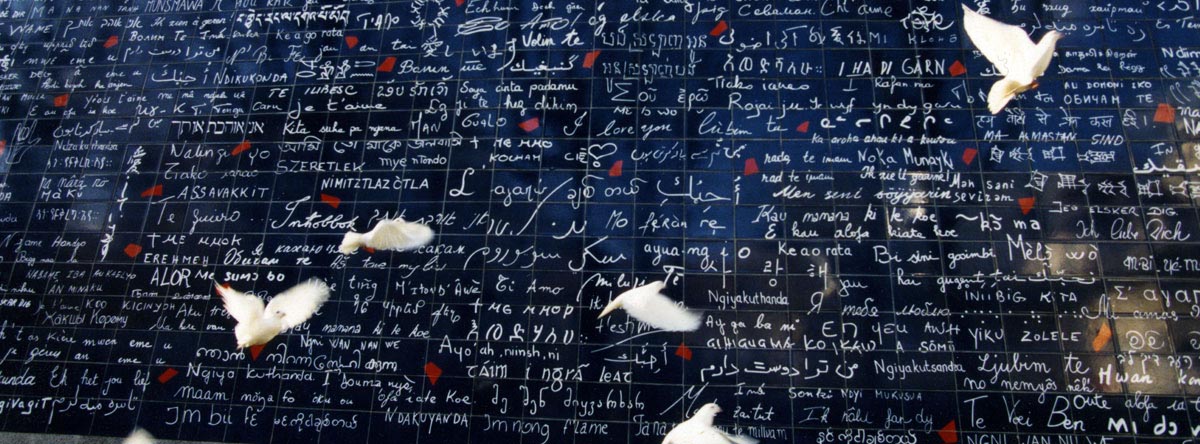
I met Frederic Baron in Spring 1997 when he showed me his collection of specimens of the words "I love you" handwritten in various languages and dialects from around the World. The mere idea of bringing together all these words of love in a gigantic fresco struck me as a wonderful project for a calligrapher!
All the "I love you's" collected affectionately by Frédéric Baron immediately fascinated me, standing as they do for both letters and for living breaths.
This project lined up well with my own approach as an artist: in painting I trace human figures as if they were writing, paying most attention to the space which unites them, separates them, brings them closer, or superposes them one on another. The relationship with the "I love you's" was obvious: the specimens of handwritten words were themselves graphic elements which I would need to connect in one single calligraphy.
In Chinese calligraphy the hand is guided by the heart, when you copy a calligraphy, you feel the spirit of the person who wrote it (in Chinese, the character "Xin" means both heart and spirit). Without ranking the samples esthetically, I considered each a complete work of its own: as I re-worked them, I preserved their rhythms and graphic characteristics, by respecting the strokes themselves whether fine or trembling, expansive or constricted.
Then all these short breaths had to be federated, setting forth their many personalities as naturally as possible, while safeguarding their legibility.
This was marvelous research into what amounts to listening to gestures.
I sat on the floor of my studio surrounded by all of these words of love. My hand took up an "I love you", a "Yiku zolélé", a "Te quiero", my choice directed by the softness or strength of the handwriting. The "I love you's" formed something of a giant puzzle. My only concern was that they hook together harmoniously to become the stones of one wall cemented by love.
Our hope that "Le mur des je t'aime" be a garden surrounded by greenery has come to be.
I trust that it will be a place for dreaming and for all people to open up to one another.
Interview by Mr. François Jaquemont (1999). Translated from French by King's Fountain.